

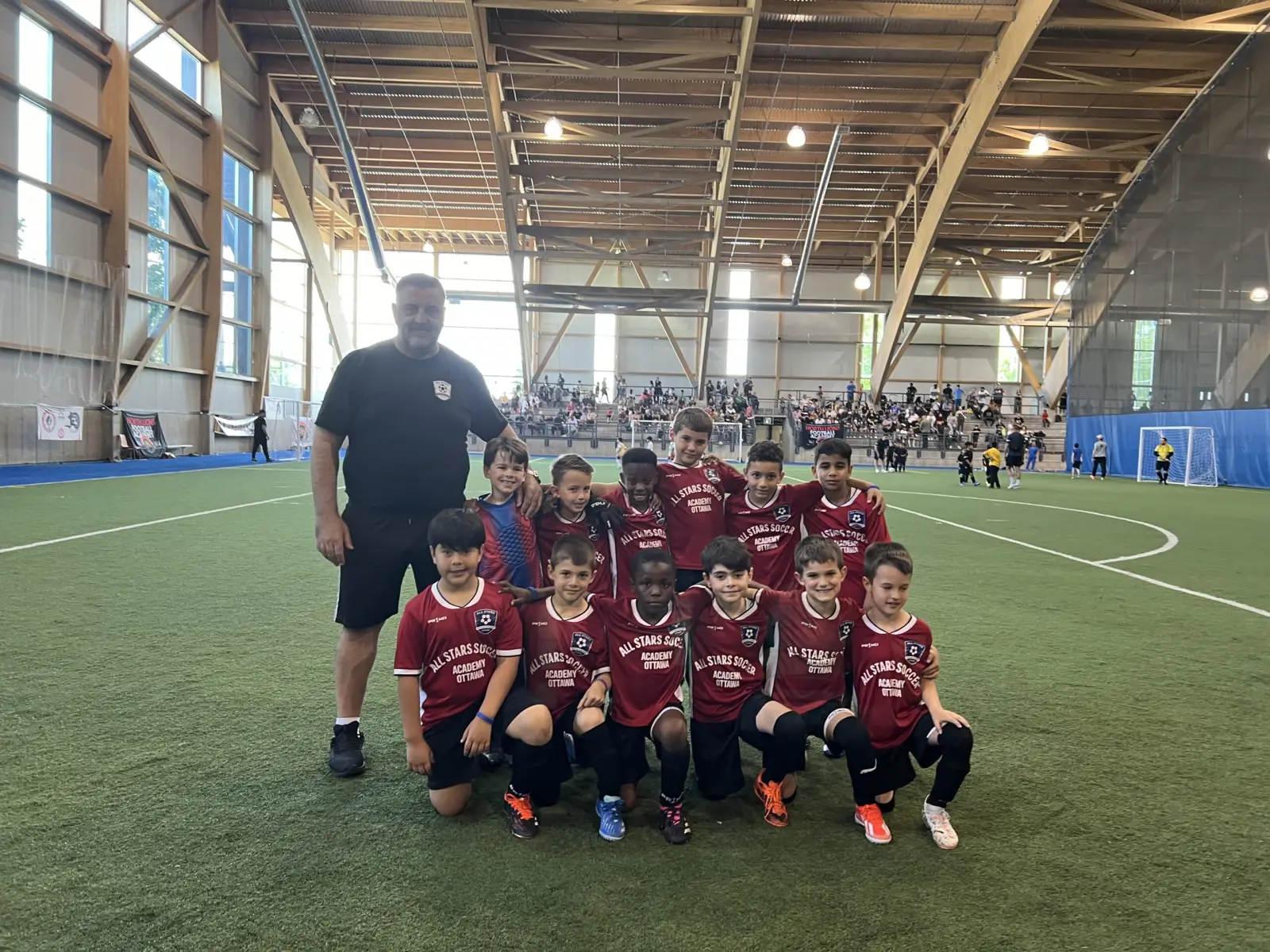
Children are not small adults, and young soccer players should not train like professionals. A five-year-old and a fifteen-year-old need completely different things from a session, even if both are wearing the same boots and chasing the same ball. Understanding youth soccer development by age helps parents ask better questions, set fair expectations and recognise good coaching when they see it.
This guide walks through the broad stages from age 5 to 16, the age range we work with at All Stars Soccer Academy Ottawa. Each stage has its own in-depth article, linked below, so you can go deeper on the years that matter to your family right now.
Why age-appropriate training matters
Canada Soccer, like most national associations, uses a long-term player development approach. The idea is simple: training should match how children grow physically, mentally and socially, rather than copying what adult teams do. The stages are described in broad age bands, and those ages are approximate. Two players born in the same year can be a long way apart in height, strength, coordination and maturity, and that is completely normal.
When training ignores these stages, a few things tend to go wrong. Young children get bored in lines and drills built for teenagers. Players in the prime skill-learning years spend too much time running laps and not enough time on the ball. Teenagers going through growth spurts get pushed too hard and pick up aches, or lose confidence because their bodies suddenly feel unfamiliar. Good coaching avoids all three.
Roughly ages 5 to 8: fun, touches and confidence
In the youngest groups, the main goal is a love of the game. Players should get the ball at their feet as often as possible, through small-sided games, dribbling challenges and playful activities that build balance, agility and coordination. Scores and standings are not the point. A child who leaves every session smiling and wanting to come back is on the right track.
Parents of new players often wonder what a good session looks like at this age, and how to help without adding pressure. Our guide to what to expect in U6 to U8 soccer covers session structure, common worries like shyness or "bunch ball", and simple things you can do at home.
Roughly ages 9 to 12: the skill-building years
Coaches often describe this stage as the best window for learning technique. Players can now concentrate for longer, understand simple ideas about space and teamwork, and repeat a skill until it sticks. This is the time for serious ball mastery, passing and receiving with both feet, striking technique, 1v1 moves and basic defending.
Small-sided games remain essential because they force constant decisions. Positions start to mean something, but players should still try different roles so they understand the whole pitch. For a detailed breakdown of the technical priorities and how to practise them, read our guide to U9-U12 soccer skills.
Roughly ages 13 to 16: growth, tactics and commitment
The teenage years bring growth spurts, and with them temporary changes in coordination. A player who was quick and tidy at twelve can look awkward for a few months at fourteen. Training adds more tactical understanding: team shape, pressing, transitions and playing out from the back. Fitness work becomes more structured, but technique still comes first, and recovery matters more than ever.
This is also when players decide how seriously they want to take the game. Some want to push toward competitive soccer; others want to keep playing for fun and fitness. Both are valuable. Our article on U13-U16 soccer training through growth spurts explains how to train well through these changes.
A skill that runs through every stage: playing from the back
Some abilities are built gradually across all the age bands. Being calm on the ball under pressure is one of them. Young players start by simply passing to a teammate instead of kicking the ball away; older players learn to scan, open their body and play through a press. We explain how this develops, and how parents can support it, in our guide to playing out from the back for young players.
What stays the same at every age
- Touches on the ball. At every stage, players improve by having the ball a lot. Sessions with long queues and lots of talking are a warning sign.
- Both feet. Weak-foot work is easiest to build early and pays off for years.
- Enjoyment. Players who enjoy training keep showing up, and showing up is how improvement happens.
- Character. Discipline, self-control and respect for teammates, opponents and referees are taught at every age, not just to older players.
- Rest and other sports. Time off, sleep and variety protect against overuse injuries and burnout.
How All Stars approaches each stage
All Stars works with boys and girls aged 5 to 16. Our sessions develop ball mastery, passing and receiving, shooting, defending, attacking and the confidence to play out from the back, while our coaches instil discipline, self-control and respect. Our values are hard and honest work, technical excellence, respect and a family-like environment, and those values apply whether a player is in their first season or their eleventh.
Players can train up to four times a week. Development programs run one, two or four sessions a week, and four sessions is about six hours of soccer. Competitive programs are offered over 3, 6 or 12 months. You can compare development and competitive programs and see current prices on the programs page, or meet the people running the sessions on our coaching team page.
Getting to training
Younger players do best with regular, shorter sessions, so a sustainable drive matters as much as the program itself. Players travel to our training base on Rouncey Rd in Kanata from close-in communities such as Stittsville, Barrhaven and Richmond, and from further out, including Carleton Place and Dunrobin. Our drive times page shows every community we see players travel from.
Next steps
Start with the stage that matches your player today, then look one stage ahead so you know what is coming. Browse every article in our player development guides, and when you are ready, create a free player profile with All Stars to get started.
Questions parents ask
At what age should my child start soccer?
There is no single right age, but many children enjoy a first program from around age 5, which is when All Stars starts. What matters most is that early sessions are playful, active and full of touches on the ball.
Should my child play up an age group if they are ahead?
Sometimes it helps, but it depends on the player's confidence, size and maturity as well as their skill. Talk to the coach first, and remember that a player who is challenged but still enjoying the game is usually in the right place.
Are the age stages strict?
No. Long-term player development stages are broad guides and the ages are approximate. Children grow and mature at different rates, so coaches should look at the individual player, not just their birth year.
When should my child start specialising in soccer only?
Most coaching guidance encourages young players to keep playing other sports through the younger years. Variety builds general athleticism and helps prevent burnout and overuse injuries, even for players who are very committed to soccer.